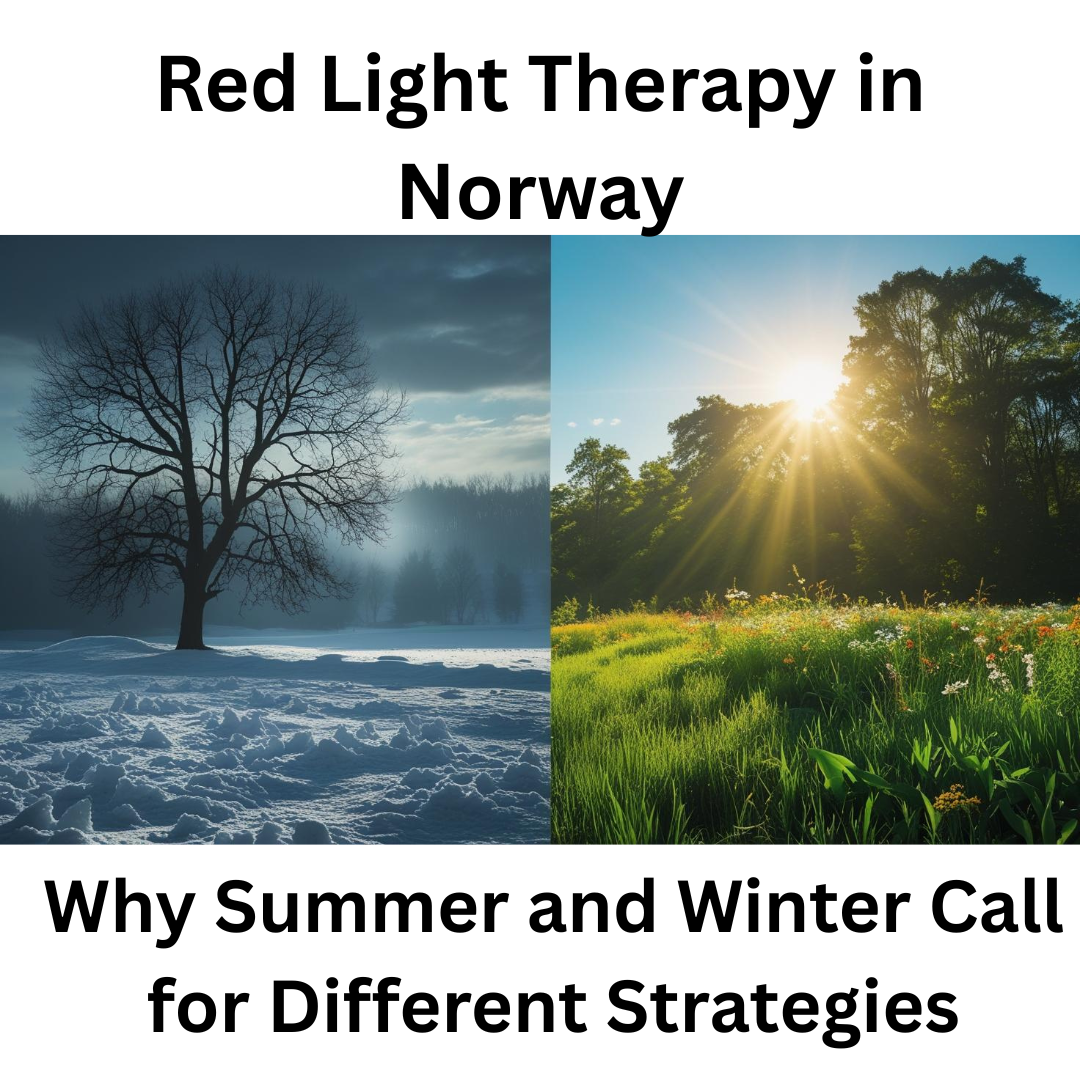
Red Light Therapy in Norway: Why Summer and Winter Call for Different Strategies
Share
Red Light Therapy in Norway: Why Summer and Winter Call for Different Strategies
Let’s talk about light—your light.
If you’ve ever felt like a completely different person in July than you do in January, you’re not imagining things. That summer glow isn’t just from the midnight sun—it’s your biology responding to light. And in Norway, where the seasons stretch light to their extremes, you can’t afford to treat red light therapy the same way year-round.
(If you’re new to this topic, you might also like our English blog archive, where we explore how light affects sleep, hormones, and health in real-world settings.)
I learned this the hard way. Being an Englishman in Norway, I felt these extremes when I first moved over here. To be honest, I still do. Years ago, when I first started red light therapy back in 2017, I assumed red light therapy was just a daily habit—15 minutes a day, no matter the season. It worked, but something shifted when I started combining it with full-spectrum sunlight in summer and leaning into it fully in winter. That’s when I really saw the difference: more energy, better sleep, improved skin, and a more stable mood.
This isn’t theory. This is what your biology is wired for. Think about it - we evolved under the sun, we evolved under broad spectrum light. The more you read, the more you realise that light actually programs us on a daily basis, so it is important to get it right. In Norway, our light exposure is very different and we need to lean into that!
Summer in Norway: Sunlight Is Medicine
July in Norway is magic. You feel better, move more, smile without trying. That’s not luck—it’s mitochondria responding to full-spectrum light.
Here’s what summer sunlight gives you:
- UVB rays: Triggers vitamin D production in your skin—essential for hormones, immunity, bones.
- Blue and green light: Set your internal clock. Wakefulness, mood, alertness—all tied to this.
- Near-infrared (NIR): Reaches deep into tissues to support cellular energy and healing.
- Oranges and Red light: Help heal the skin from any potential damage from shorter wavelength light
When your bare skin and eyes (without sunglasses) get light exposure, your body recalibrates. Cortisol, melatonin, testosterone, estrogen—they all shift.
During summer, Get outside. Use the real light nature built for you. Use specific target red light therapy or photobiomodulation devices that provide greater light intensity in the red and near infrared on areas that need it.
Summer Strategy:
- Go outside before 9 a.m. and around noon (This depends on skin type)
- Expose bare skin for 15–30 minutes (no sunscreen initially).
- Skip the red light panel unless treating specific issues.
- Ground - get bare feet on natural surfaces like grass, sand, clay or mud to gain some free electrons
This is your chance to load the biological battery.
Winter in Norway: Red Light Therapy Is Essential
Winter.... or the cold weather can start early in Norway. Clothes go on and more time is spent indoors. It’s dark when you wake. Dark again by dinner. And it’s not just your mood that changes—your mitochondria slow down and your biological battery remains only half charged.
This is when red light therapy becomes your biological support system.
Red and near-infrared light stimulate the mitochondrial enzyme cytochrome c oxidase, helping your cells produce more energy (ATP). This matters when your natural light exposure is nearly zero.
Red light therapy in winter helps to:
- Restore energy production: Cellular ATP rises, fatigue drops.
- Reduce inflammation: Especially helpful for skin, joints, and mood.
- Reset your body clock: Morning light cues help recalibrate hormones and sleep.
I use mine every morning. Sometimes again in the afternoon if energy crashes. It’s not a full replacement for the sun—but it’s the bridge to keep you going until March where I begin to charge up from sunlight again (Yes its still very cold, but it's worth it to get sun on my skin).
Winter Strategy:
- Use red light therapy daily before 9 a.m.
- Expose face, chest, neck torso—areas with systemic benefit.
- Keep it consistent. Don’t skip cloudy days. They’re all cloudy.
- If possible use a grounding mat or grounding sheet to keep yourself connected to the earth and the free electrons to maintain some charge (Products can be found here)
Looking for a quality device to support your winter protocol? View our red light panel collection. All panels are tested with a spectrometer and personally vetted by me.
Spring and Autumn: Transition Zones
Spring and autumn can throw you off. Light is inconsistent. Days are shifting. You need to adapt gradually.
In spring:
- Start outdoor light sessions slowly (5–10 minutes).
- Keep using red light in the morning until sunlight is strong.
In autumn:
- Move red light sessions earlier in the day.
- Increase exposure as outdoor time decreases.
These seasons are where most people lose rhythm and start to feel lethargic. Plan ahead and you’ll avoid the winter crash. Keep your light for as long as possible, maintain grounding practices and if you want to - start to increase cold exposure as well as red light therapy exposure.
Curious about how circadian rhythm affects your health long-term? Check out our post: Circadian Rhythm Explained.
If You Work Indoors All Year
Not everyone gets to bask in sun at 2 p.m. I understand that and I can empathise with you. Many of us work inside—offices, hospitals, schools—missing even summer light.
Do this in summer:
- Take your lunch outside—no sunglasses.
- Open windows, sit near natural light.
- Use red light primarily in the morning and when recovering or treating specific issues. Otherwise get outdoor exposure before and after work.
Do this in winter:
- Daily red light therapy before 9 a.m.
- Dawn simulation alarms to mimic sunrise.
- Swap overhead lights for full-spectrum bulbs and use appropriate lighting in the evening time such as low blue lighting
One of our most popular tools for winter support is the PulseWave Pro. It delivers both red and near-infrared light at safe, effective levels—perfect for dark months in Norway.
You can’t always change your job. But you can change your environment.
The Norwegian Seasonal Light Protocol
Summer (May–August)
- Prioritise sunlight/daylight exposure.
- Use red light only if needed (for example for aches and pains, Morning or evening).
- Expose skin as early in the day as possible as this helps to prime the skin and also has lower levels of UV which is good for people with sensitive skin and when trying to build a solar callous.
Winter (November–February)
- Red light therapy daily (morning sessions, evening if needed).
- Get outside midday even on cloudy days.
- Support with vitamin D and good sleep routine.
Spring & Autumn (March–April, Sept–Oct)
- Transition gradually.
- Adjust red light use to match your natural exposure.
- Pay attention to how you feel, not just the calendar.
Final Thought from Me
Years ago, I didn’t know any of this. I just knew I felt awful in winter and amazing in summer. Once I started aligning my light environment with the seasons—something clicked. It helped me get out from the lows and I haven't been back since. Use red light therapy as a tool in your arsenal, not the only tool.
The panels I sell, the lighting I recommend, the protocols I follow—they’re not just tools. They’re about remembering what our biology expects. Nature gave us a blueprint. We just need to follow it again.
So this summer, get outside. Let the sun hit your face. Let your biology remember what it means to be alive. And in winter? Support your light needs with intent. Red light therapy won’t replace the sun, but it’ll help you hold the line until it returns.
You live in Norway. Light isn’t optional. It’s essential.
— Dominic Lamb, Home Light Therapy