

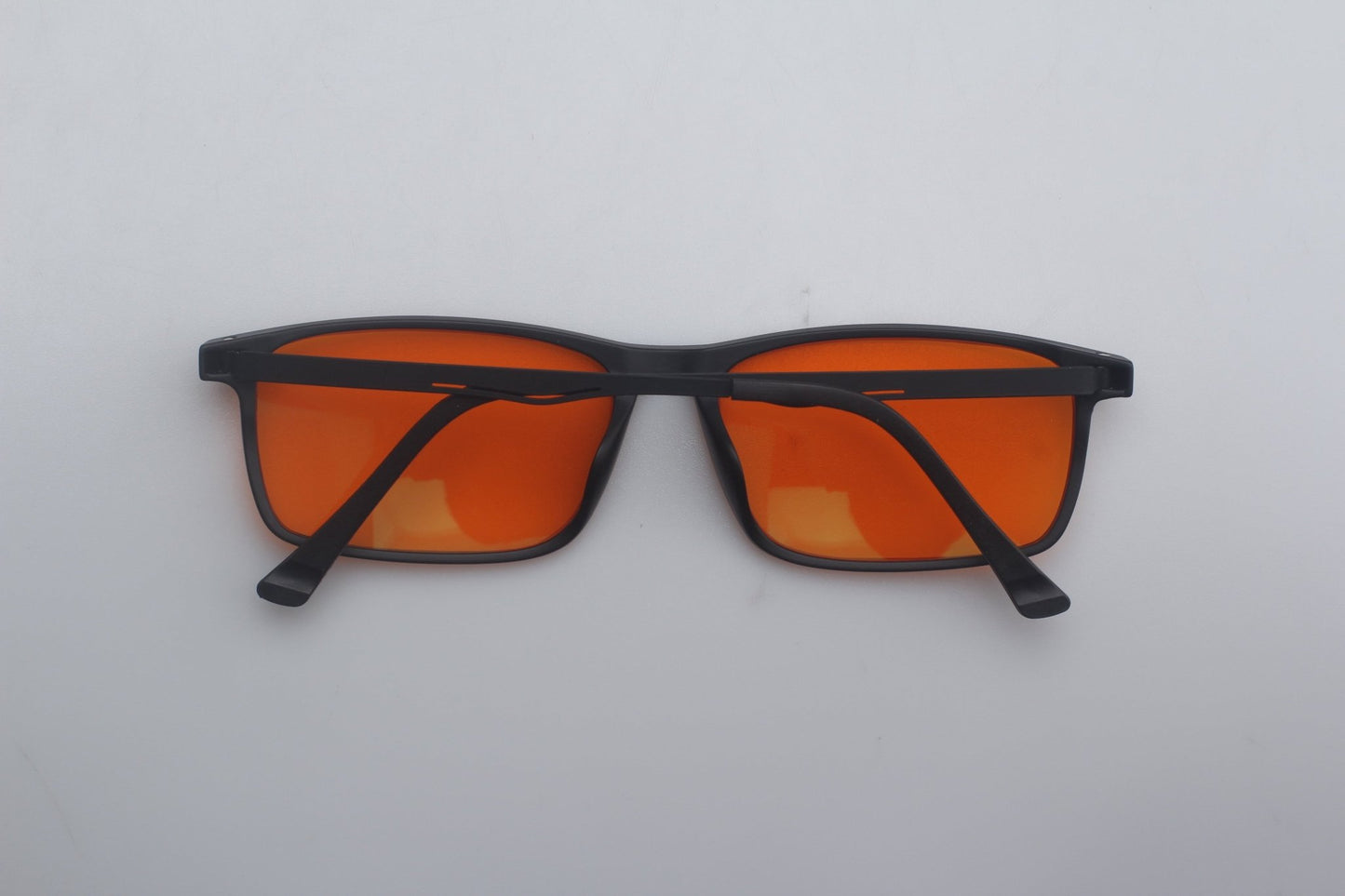
AfterDark Titanium Blue Light Blocking Glasses
Rubber titanium frame, 8 grams, wide 59mm lens. Spectrometer-tested Amber and Red blocking. Ships from Drammen.
(Blålysbriller i gummi-titan, 8 gram, spektrometer-testet, sendes fra Drammen)
When you want something that feels built to last
Most blue light glasses are plastic. The AfterDark Titanium uses a rubber titanium construction, a titanium alloy core with a matte rubber finish. That combination gives you a frame that's genuinely light at 8 grams, resistant to bending out of shape over time, and non-slip against your face during long evening sessions.
The wide 59mm lens and full-box frame give solid peripheral coverage, less light leaking in from the sides compared to a narrower frame. If you're serious about the science behind why that matters, the blue light biology post on the blog covers how peripheral retinal exposure still suppresses melatonin even when you're not looking directly at a screen.
How many hours before bed should you put on blue light glasses?
Put Amber lenses on 2-3 hours before your target bedtime, then switch to Red for the final 60-90 minutes. I've tested this timing on myself since 2018, and starting too late is the single biggest reason people say blue light glasses "don't work." Amber blocks 97% of blue light, Red blocks over 99%.
Frame construction
- Rubber titanium: titanium alloy core with matte rubber coating; non-slip grip on the nose and temples
- Full-box frame: complete lens surround for structural rigidity and better peripheral blocking
- 8 grams: lighter than most full-box plastic frames; comfortable for 2-3 hours of evening use
- Wide 59mm lens: reduces peripheral light bleed compared to narrower lens profiles
- Corrosion resistant: titanium resists sweat and humidity; holds up well in daily carry
Frame dimensions
Manually measured. Allow 1-3mm tolerance. The 150mm frame width suits medium to larger face sizes.
Two lenses. Choose by time of evening.
Amber lens, 97% blue light blocked
- Targets the 380-500nm range where melanopsin suppression is greatest
- Colour visibility stays reasonable for reading, TV and moving around the house
- Put them on 2-3 hours before your target bedtime and leave them on
- The right starting point for most people on most evenings
- Spectrometer-verified, not a supplier claim
Red lens, 99%+ blue and green light blocked
- Covers the full 380-550nm range including green wavelengths the amber misses
- Maximum melatonin protection for the final 60-90 minutes before sleep
- The lens for Norwegian summer evenings when it's still light at 10pm
- Heavy colour shift, use when you're winding down and not moving around
- Spectrometer-verified at 99%+ across the target spectrum
Why AfterDark Titanium
Norwegian light extremes, summer and morketid
Summer: ambient outdoor light stays intense well past 10pm across most of Norway. The combination of late daylight and indoor LED screens means your melanopsin receptors get almost no break in the evening. Red lenses from 8pm give your melatonin signal a fighting chance against lysarstid.
Morketid: the sky is dark but your indoor environment isn't. Standard LED bulbs in Norwegian homes run at colour temperatures that still spike in the blue range, suppressing melatonin across 16+ hours of indoor time. Amber lenses from late afternoon, every evening through winter, combined with low-blue circadian bulbs in the main living areas, is the full solution.
What's in the box
The rest of the AfterDark range
Prefer a different frame style? The Quantum has a round retro profile in TR90 flex. The Smooth is a contemporary everyday frame also in TR90. The Meridian includes four magnetic lens swaps covering all protection levels in one package. For daytime screen use without suppressing morning alertness, the Nooner is the daytime option.

From Dominic
The Titanium is for people who want something that feels a bit more solid than a flex-polymer frame. Eight grams is genuinely light, most people are surprised when they first pick it up. The wide lens is the other thing worth noting: if you sit in a bright room in the evenings, the extra lens width makes a real difference to how well the glasses actually do their job. Start with Amber, wear them from dinner, and add Red for the final hour before sleep if you want maximum cover.
📧 admin@lighttherapy.no · 📞 +47 951 47 478 (Text only)
Important, not for driving or machinery
Both Amber and Red lenses significantly alter colour perception. Do not use while driving, cycling on roads, or operating any machinery. Indoor, stationary evening use only.
🚚 Ships from Drammen, no import fees within Norway
🛡️ 30 dagers åpent kjøp
Full refund within 30 days.
🔧 12-month warranty
Questions people actually ask
Hva gjør gummi-titan annerledes enn vanlige plastrammer?
Rubber titanium combines a titanium alloy core with a rubber-coated finish. This gives the frame strength and corrosion resistance from the titanium, and a non-slip matte grip from the rubber coating. At 8 grams the frame is lighter than most full-box plastic frames, and the rubber finish means it stays in place on your face rather than sliding down during long evening sessions.
What is the difference between Amber and Red lenses?
Amber blocks approximately 97% of blue light across the 380-500nm range. It maintains enough colour visibility for normal indoor activities such as reading, TV and moving around the house. Red blocks over 99% of both blue and green light across 380-550nm, which is maximum melatonin protection. Use Amber from 2-3 hours before sleep, Red for the final 60-90 minutes or during Norwegian summer evenings when daylight runs late.
Hva betyr 97% og 99% blokkeringsprosent i praksis?
Prosentene er målt med spektrometer og viser hvor mye av det blå lysspekteret (380-500nm) som faktisk stoppes av linsen. 97% amber-linse betyr at nesten alt blått lys fra skjerm og LED-belysning blokkeres, men at fargepersepsjonen forblir brukbar. 99%+ rød linse blokkerer i tillegg grønt lys (opp til 550nm), noe som gir maksimal melatonin-beskyttelse de siste 60-90 minuttene før søvn.
Are the lenses spectrometer-tested?
Yes. Amber: 97% blue light blocked. Red: 99%+ blue and green light blocked. These figures come from spectrometer measurements across the full 340-1000nm spectrum, not from a supplier datasheet.
Hvem passer AfterDark Titanium for?
Anyone who wants a full-coverage, wide-lens blue light frame that feels more substantial than a flex-polymer frame. The wide 59mm lens and full-box frame provide good peripheral coverage. The rubber titanium construction suits people who want a frame that won't shift position during extended evening use.
Trenger jeg blålysbriller hvis jeg allerede har varmere belysning hjemme?
Ja. Sirkadiansk belysning og blålysbriller løser ulike problemer. Belysningen kontrollerer rommet, men telefonen, PC-en og TV-en sender ut blått lys uavhengig av hva taklampene gjør. For full kontroll over lysmiljøet om kvelden trenger du begge deler.
What frame dimensions should I check before ordering?
Frame width 150mm, lens width 59mm, frame height 41mm, nose spacing 16mm, temple length 152mm. These are manually measured with a tolerance of 1-3mm. The wide 150mm frame width suits medium to larger face sizes.