

SleepGuard - Plug-In Amber Night Light with Continuous, Motion or Off Modes
Bevegelsesaktivert eller kontinuerlig søvnvennlig nattlys uten blått lys - for trygg nattkvalitet
Soft 1800K amber, flicker-free, with light cast both up and down from the plug. Run it continuously, let it activate on motion, or turn it off, your choice, night to night. Plug in once, works for years without maintenance.
Why this amber night light handles the 3am problem
Most people fix their evening light environment with circadian bulbs and blue light blocking glasses, then undo all of it at 3am when they get up for the bathroom and switch on a bright white overhead light. That single exposure is often enough to suppress melatonin, raise alertness and make falling back to sleep noticeably harder.
The SleepGuard is the fix for that last gap. It plugs into any outlet and casts a soft 1800K amber glow both upward and downward, so it lights the floor in front of you and the space above without a harsh single beam. Set it to motion mode and it activates as you approach, stays on for 30 to 90 seconds, then goes off, or leave it on continuous if you'd rather it just stay lit. The 1800K amber wavelength sits outside the melanopsin activation range either way, so your sleep chemistry stays roughly where it should be.
- Three modes, continuous, motion-activated, or off, switchable whenever your routine changes
- Up and down illumination, light spreads both above and below the unit rather than a single harsh beam
- Flicker-free, stable current at every brightness level, in every mode
- 1800K amber, sits outside the blue wavelength range that drives melatonin suppression
- Dusk-to-dawn sensor, governs motion mode specifically, so it won't trigger during the day
Three modes, one plug
Stays on at your chosen brightness until you switch it off. Good for bathrooms during illness, pregnancy, or when guests are staying.
Activates when it detects movement, holds for 30-90 seconds, then goes off automatically. The lowest-exposure option for normal nightly use.
Fully off, no standby glow. Flip it back on to continuous or motion whenever you need it.
How long should a night light stay on after it detects motion?
Long enough to see, short enough to matter. I set mine to 30 seconds for the bathroom, just enough for a quick trip and back to bed. Longer feeds or extended time awake call for continuous mode instead of resetting motion timers over and over through the night.
What it protects you from
Melatonin protection
1800K amber produces minimal melanopsin activation. You can navigate and return to bed with your melatonin profile essentially intact, unlike flipping on a standard white light.
Won't wake others
Localised soft glow, cast both up and down rather than out as a single beam. Enough for one person to move through a space without broadly lighting the room or waking a partner or child.
No charging or batteries
Permanent plug-in power. Works every night without maintenance, nothing to remember or recharge at exactly the moment you need it.
No flicker
Runs on stable current rather than rapid PWM dimming, so there's nothing to strain sensitive eyes even during extended continuous use.
Right mode for the moment
Motion mode for the lowest-exposure option most nights. Continuous mode when you want a fixed, reliable glow, a bathroom during illness, a nursery during a long feed, a hallway with guests staying.
Easy installation
Plug directly into any standard outlet. No wiring, no tools, no setup beyond plugging in and choosing your mode, brightness and timer.
Who needs this
New parents and night feeds
Motion mode activates when you enter the room for a quick check; continuous mode keeps it lit through a longer feed without re-triggering. Either way, no blue light blast that makes returning to sleep harder for you or the baby.
Anyone managing sleep quality
If you've sorted your evening light environment but still struggle after nighttime waking, this is usually the missing piece, the one exposure event you can't fix with glasses or bulbs alone.
Elderly and mobility-limited households
Motion mode gives automatic amber light with no switch to operate, a practical safety upgrade that reduces fall risk. Continuous mode is an option too, for anyone who prefers a light that's simply always there. CE certified, cool-touch surface, child and elderly safe.
Shift workers and irregular schedules
When your sleep windows don't align with normal daylight hours, protecting those windows matters even more. Motion or continuous, whichever suits your routine that day.
Technical features
- 1800K warm amber, soft colour temperature outside the blue-sensitive range
- Up and down illumination, light cast both above and below the unit
- Flicker-free, stable current, no PWM, at any brightness or mode
- Three modes, continuous, motion, or off
- Motion sensor: 3 to 5 metre range, adjustable sensitivity, active in motion mode
- Dusk-to-dawn sensor, governs motion mode; arms only in darkness, off during daylight
- Adjustable brightness, low, medium, high, in every mode
- Programmable auto-off, 30, 60, or 90 seconds, in motion mode
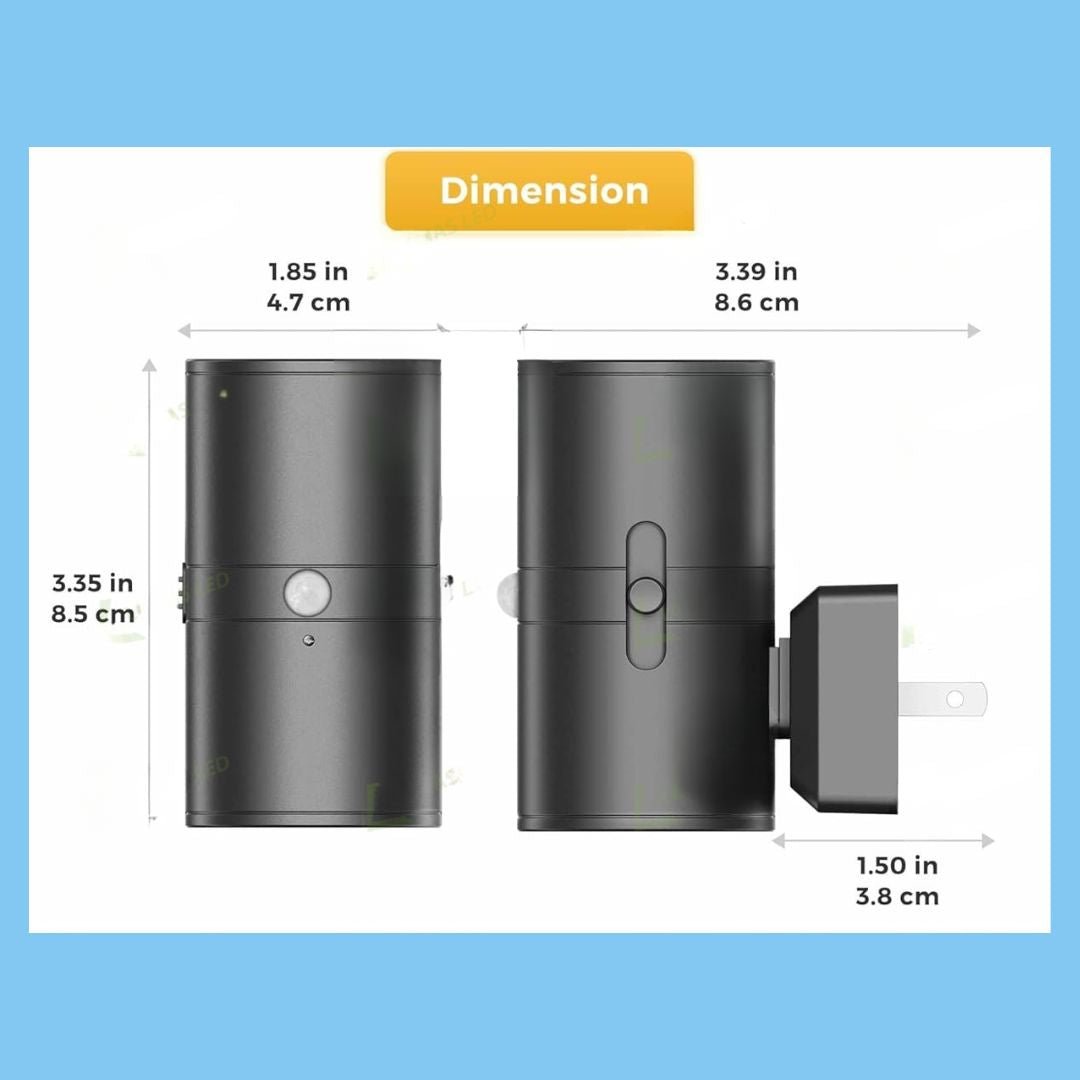
- Low-profile design, compact plug-in form doesn't block adjacent sockets
- Cool-touch surface, safe around children and the elderly
- Under 1W power consumption, negligible running cost
- 50,000+ hour LED lifespan, effectively maintenance-free for decades
- CE certified, standard outlet, no special wiring
SleepGuard vs standard white night light
| Feature | SleepGuard 1800K amber | Standard white night light |
|---|---|---|
| Wavelength | 1800K amber, outside blue peak | Blue-white LED, 480nm+ peak |
| Melatonin impact | Minimal melanopsin activation | Significant suppression risk |
| Modes available | Continuous, motion, or off, your choice | Usually fixed always-on only |
| Flicker | None, stable current | Often PWM-dimmed |
| Light spread | Up and down illumination | Typically single-direction |
| Partner disturbance | Localised soft glow | Room-level illumination |
| Circadian signal | Reads as night | Partial wake signal |
The science behind 1800K amber
Melanopsin, the photopigment in intrinsically photosensitive retinal ganglion cells (ipRGCs) responsible for circadian melatonin regulation, has peak sensitivity around 480nm (blue-cyan). Standard white and cool-white LEDs emit strongly in this range, which is why even brief nighttime blue light exposure is associated in research with melatonin suppression and delayed sleep recovery.
Amber at 1800K has a spectral distribution centred well into the warm orange-red range. Melanopsin activation at these wavelengths is substantially lower than at blue-enriched wavelengths, whether the light is running in motion mode for seconds or continuous mode for hours. The full underlying research is covered on my photobiomodulation and light research page.
The underlying science is well-established; individual responses vary. Not a clinical device.
Where to place it
Bathroom
My own SleepGuard lives in the bathroom, usually on motion mode, it's the single most common nighttime trip, and up-and-down illumination means I can see the floor and the sink without a harsh single beam.
Outside the bedroom door
I keep a second one just outside my own door on continuous. Enough amber glow to see the corridor immediately without needing to find a switch first.
Stairs
One of the higher-risk locations for nighttime movement. Motion mode gives automatic amber illumination without any switch operation.
Baby's room, night feeds
Motion mode for a quick check, continuous mode for a longer feed. Amber wavelength keeps both parent and baby in sleep mode either way.
Norske vinternetter og mørketid
Under norsk mørketid, fra oktober til mars, navigerer mange i total mørke flere ganger per natt. Det SleepGuard gjør er enkelt: den gir deg amberlys i 30 til 90 sekunder når du trenger det, uten å tilbakestille melatoninprofilen din, eller du kan la den stå på kontinuerlig gjennom de mørkeste månedene. Sett den inn en gang ved starten av vinteren, og glem den. Det beste nattlyset for søvn er ett du aldri tenker på.
Complete the nighttime environment
- Bedroom overhead: Blue light free evening bulb for the hours before sleep, the SleepGuard takes over when you go to bed
- Kids' bedside: Wireless kids' amber lamp, touch-controlled bedside amber for children who need a light they can control themselves
- Battery-powered version: Cordless motion sensor light, for rooms without a nearby outlet
- Screen coverage: AfterDark blålysbriller, the glasses handle screens before bed, the SleepGuard handles the rest of the night
- Full circadian range: All sirkadisk belysning products, the complete circadian lighting collection
Technical specifications
| Light colour | Soft amber 1800K |
| Light direction | Up and down (dual beam) |
| Modes | Continuous / Motion / Off |
| Flicker | None, stable current, no PWM |
| Motion detection | 3 to 5 metres (adjustable sensitivity), motion mode only |
| Auto-off timer | 30 / 60 / 90 seconds (adjustable), motion mode only |
| Brightness | Low / Medium / High |
| Dusk-to-dawn | Yes, governs motion mode, won't trigger in daylight |
| Power source | Plug-in (standard outlet) |
| Power consumption | Under 1W |
| LED lifespan | 50,000+ hours |
| Certifications | CE certified |
| Safe for | Children and elderly (cool-touch, no batteries) |
| Warranty | 1 year |

From Dominic
I run two of these myself, one in the bathroom on motion mode, one just outside my bedroom door on continuous. The up-and-down light is genuinely nice to live with, not just a spec sheet line; it fills the space instead of throwing one hard beam at the floor. People who've done all the right things with their evening light environment and still struggle to fall back to sleep after getting up at night often find this closes the gap. It costs almost nothing to run and handles the one exposure event you can't control with glasses or bulbs alone. If you're building a full circadian setup, I'd add this alongside the circadian lighting collection.
Contact: admin@lighttherapy.no · +47 951 47 478 (Text only)
Ships from Drammen, no import fees
30 dagers åpent kjøp
Full refund within 30 days.
1-year warranty, CE certified
Frequently asked questions
What is the best night light for sleep that won't disrupt melatonin?
A melatonin-safe night light uses amber or red wavelengths (1800K or lower) rather than white or blue-white LEDs. The SleepGuard uses 1800K amber, which sits outside the melanopsin activation range concentrated around 480nm blue-cyan. In motion mode, activation is also limited to seconds at a time, so even the brief light-on period causes minimal disruption to your sleep chemistry.
Can I use it as an always-on light, or only with motion?
Both, the SleepGuard has three settings: continuous (always on), motion-activated (lights only when it detects movement, then times out automatically), and off. Many people run it on continuous in a bathroom during illness, pregnancy, or when guests are staying, then switch back to motion mode for normal use.
Is the light flicker-free?
Yes. The SleepGuard runs on stable current with no PWM flicker at any brightness level or in any mode, which matters for anyone sensitive to flicker-related eye strain or headaches.
Will this wake my sleeping partner?
The soft amber glow is localised and low-output. It illuminates your path without broadly lighting the room or disrupting a sleeping partner.
Is it good for night feeds and new parents?
Genuinely useful here. In motion mode it activates when you enter the room, gives you enough amber light to see during the feed, then turns off. For longer feeds, continuous mode keeps it lit without re-triggering. The 1800K amber wavelength won't trigger the melanopsin pathway in you or the baby, which makes returning to sleep much easier than if you'd switched on a standard white light.
How far does the sensor detect?
3 to 5 metres with adjustable sensitivity, in motion mode. Activates within seconds of motion in the detection zone.
Can I adjust brightness and timer?
Yes. Low, medium and high brightness settings apply in every mode. The programmable auto-off timer (30, 60 or 90 seconds) applies to motion mode, continuous mode just stays on until you switch it off.
Fungerer den i dagslys?
In motion mode, no, the dusk-to-dawn sensor only enables motion detection in darkness. In continuous mode, it stays on regardless of ambient light until you turn it off.
Is 1800K amber really better than white light at night?
Yes. Melanopsin activation, the mechanism behind nighttime melatonin suppression, peaks around 480nm (blue-cyan). White LEDs emit strongly in this range. Amber at 1800K sits well outside it, producing far less melanopsin activation. The science here is well-established across multiple independent studies.
Hva er det beste nattlyset for søvn uten å forstyrre melatonin?
The best night light for sleep uses amber or red wavelengths (1800K or lower) instead of white or blue-white LEDs. At 1800K, amber sits well outside the melanopsin activation range concentrated around 480nm (blue-cyan), so melatonin suppression stays minimal even while the light is on. Motion mode reduces total exposure further by limiting the light to only the seconds you're actually moving.
Kan lampen stå på kontinuerlig, eller kun ved bevegelse?
Both. The SleepGuard has three settings: continuous, motion-activated, and off. Many people run it on continuous in a bathroom during illness or pregnancy, then switch back to motion mode for normal use.
Er lyset flimmerfritt?
Yes. The SleepGuard runs on stable current with no PWM flicker at any brightness level, which matters for anyone sensitive to flicker-related eye strain or headaches.
Hjelper amber nattlys under mørketid i Norge?
Yes. During Norwegian mørketid, from October to March, many people navigate in complete darkness several times a night. The SleepGuard gives you amber light for 30 to 90 seconds exactly when you need it in motion mode, without resetting your melatonin, or you can leave it on continuous through the darkest months. Plug it in once at the start of autumn and forget about it.
Er det trygt for barn og eldre?
Yes. Cool-touch surface, no sharp edges, and it plugs into a standard outlet so there are no batteries to manage. Motion mode means nobody needs to operate a switch in the dark, and continuous mode means it's simply always there. CE certified.