

AfterDark Architect Blue Light Blocking Glasses
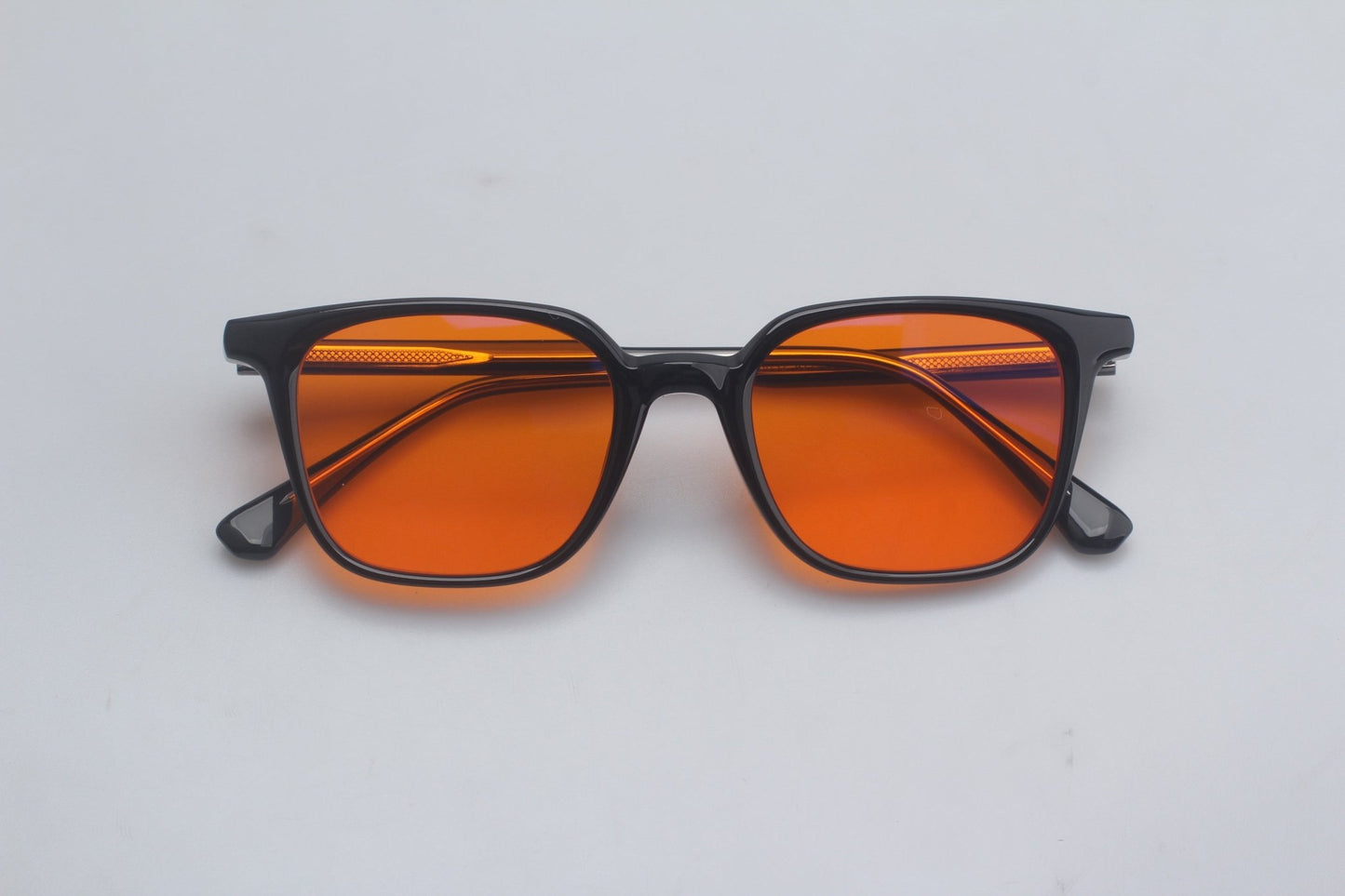
Squared TR+CP frame with metal-reinforced temple arms. Spectrometer-tested Amber and Red lenses. Ships from Drammen.
(Firkantede blålysbriller med metallforsterkede stenger, spektrometer-testet, sendes fra Drammen)
A frame built for a desk, not a beach
Most blue light glasses are round and casual. The Architect isn't. It's a squared, slightly heavier profile with metal-reinforced temple arms, the kind of shape that reads as an ordinary pair of glasses on a video call instead of announcing "these are my sleep glasses" the moment a colleague pops up on screen at 8pm.
That matters if you're still answering emails at dinner time. Read more about why Norwegian evenings wreck your energy and how the light around you feeds into that, on the blog.
Why does spectrometer testing matter for blue light glasses?
Spectrometer testing measures exactly how much blue light a lens blocks across the full spectrum, not what a supplier sheet claims. I test every AfterDark lens myself before it goes on the site: 97% blocked on Amber, 99%+ on Red, verified from 340 to 1000nm. Cheap glasses skip this step entirely.
The frame, practical details
- Full acetate front, squared TR+CP construction with no metal on the frame front
- Metal-reinforced temple arms, a metal core inside the acetate temples for shape retention over years of daily use
- Weighs approximately 22.4g, light enough to forget you're wearing it through a long evening
- Unisex fit, suited to most adult face shapes
- UV400 certified for full UV protection
Manually measured. Allow 1 to 3mm tolerance.
Two lenses, choose by time of evening
Amber lens, 97% blue light blocked
- Targets the 380 to 500nm range where melanopsin activation is highest
- Keeps enough colour visibility for reading, video calls, general desk work
- Put them on 2 to 3 hours before your target bedtime and leave them on
- Works well for a late work session that runs into the evening
- Spectrometer-verified, not a supplier claim
Red lens, 99%+ blue and green light blocked
- Covers the full 380 to 550nm range, including the green wavelengths amber misses
- Maximum melatonin protection for the final 60 to 90 minutes before sleep
- Worth switching to earlier during Norwegian summer, when daylight runs past 10pm
- Heavy colour shift, so it's for stationary, relaxed use only
- Best kept for after the laptop is closed for the day
What's actually happening in your eyes
Your retina has melanopsin photoreceptors, intrinsically photosensitive retinal ganglion cells, tuned to short-wavelength blue and cyan light. When they detect it, they signal the suprachiasmatic nucleus, your brain's central clock, that it's still daytime. Melatonin release gets suppressed, even if it's 11pm and you're exhausted.
Block those wavelengths with Amber or Red in the evening and that false daylight signal goes away. Melatonin rises on schedule instead. Most people notice they feel sleepier at their usual bedtime within a few nights, especially if they were previously working right up until the lights went off. The circadian lighting collection covers how this extends to your room lighting too, not just what's on your face.
Why AfterDark Architect
Norway runs on extremes, and your glasses need to match
Summer: the sun's still up past 10pm in Oslo, later further north. Daylight keeps melatonin suppressed late, then you come indoors to LED screens and keep going. Red lenses earn their keep from around 8pm during lysårstid.
Mørketid: dark outside from 3pm, but you're under full-spectrum LED bulbs until midnight, emitting the same short-wavelength light as a summer sky. Amber from late afternoon, every evening through winter, paired with the same principle behind circadian lighting, applied to what's on your face instead of your ceiling.
What's in the box
The rest of the AfterDark range
Prefer something rounder? The Quantum is a round Amber and Red pair. Want more heft and a wider lens? The Titanium uses a rubber titanium build at 8 grams. The Meridian gives you four magnetic lens swaps in one frame, and for daytime screen work that shouldn't touch your morning alertness, the Nooner uses a yellow lens built for daytime use.

From Dominic
The Architect is the pair I hand to people who tell me they'd never wear "sleep glasses" because they look odd on a video call. This frame doesn't. Start with Amber, put them on around dinner time, and give it a week before you judge anything. Swap to Red for the last hour if you're a light sleeper, or straight through a bright Norwegian summer evening. Not sure which lens or frame suits you? Get in touch and I'll walk you through it myself.
📧 admin@lighttherapy.no · 📞 +47 951 47 478 (Text only)
Important: not for driving or machinery
Both Amber and Red lenses significantly alter colour perception. Do not use while driving, cycling on roads, or operating any machinery. These are indoor, stationary evening glasses.
🚚 Ships from Drammen. No import fees within Norway
🛡️ 30 dagers åpent kjøp
Full refund within 30 days.
🔧 12-month warranty
Questions people actually ask
What makes the Architect frame different from the other AfterDark styles?
The Architect uses a squared TR+CP frame with a full acetate front and metal-reinforced temple arms, a more structured shape than the round Quantum or the rubber titanium build of the Titanium. At 22.4 grams, it reads as an ordinary pair of glasses on a video call.
Amber or Red, which lens should I start with on the Architect?
Amber for most evenings. Put them on 2-3 hours before bed and keep them on through dinner, screens and general downtime. Switch to Red for the final 60-90 minutes, or move to Red earlier during Norwegian summer when it is still bright outside at 9 or 10pm.
How much blue light do the Amber and Red lenses actually block?
Amber blocks 97% of blue light. Red blocks over 99% of both blue and green light. Both figures are spectrometer-measured across the 340-1000nm range, not supplier estimates.
Hva er forskjellen mellom amber- og rødlinse på Architect-modellen?
Amber blocks 97% of blue light and suits early evening use while you're still working or watching TV. Red blocks over 99% of both blue and green light and is meant for the final hour before sleep, or for bright Norwegian summer evenings.
Passer Architect-brillene til hjemmekontor om kvelden?
Yes. The squared frame was chosen specifically because it looks like ordinary eyewear on a video call. Most people wear Amber while still working and switch to Red once the screen is off for the day.
Er det trygt å kjøre bil eller sykle med disse brillene på?
No. Both Amber and Red lenses significantly alter colour perception. They are built for indoor, stationary evening use only, not driving, cycling on roads, or operating machinery.
Er Architect-brillene nyttige i mørketiden?
Yes. The winter problem isn't sunlight, it's sitting under artificial LED lighting for many hours a day. Wearing the Amber lens from late afternoon through the dark season helps melatonin production stay on schedule.