

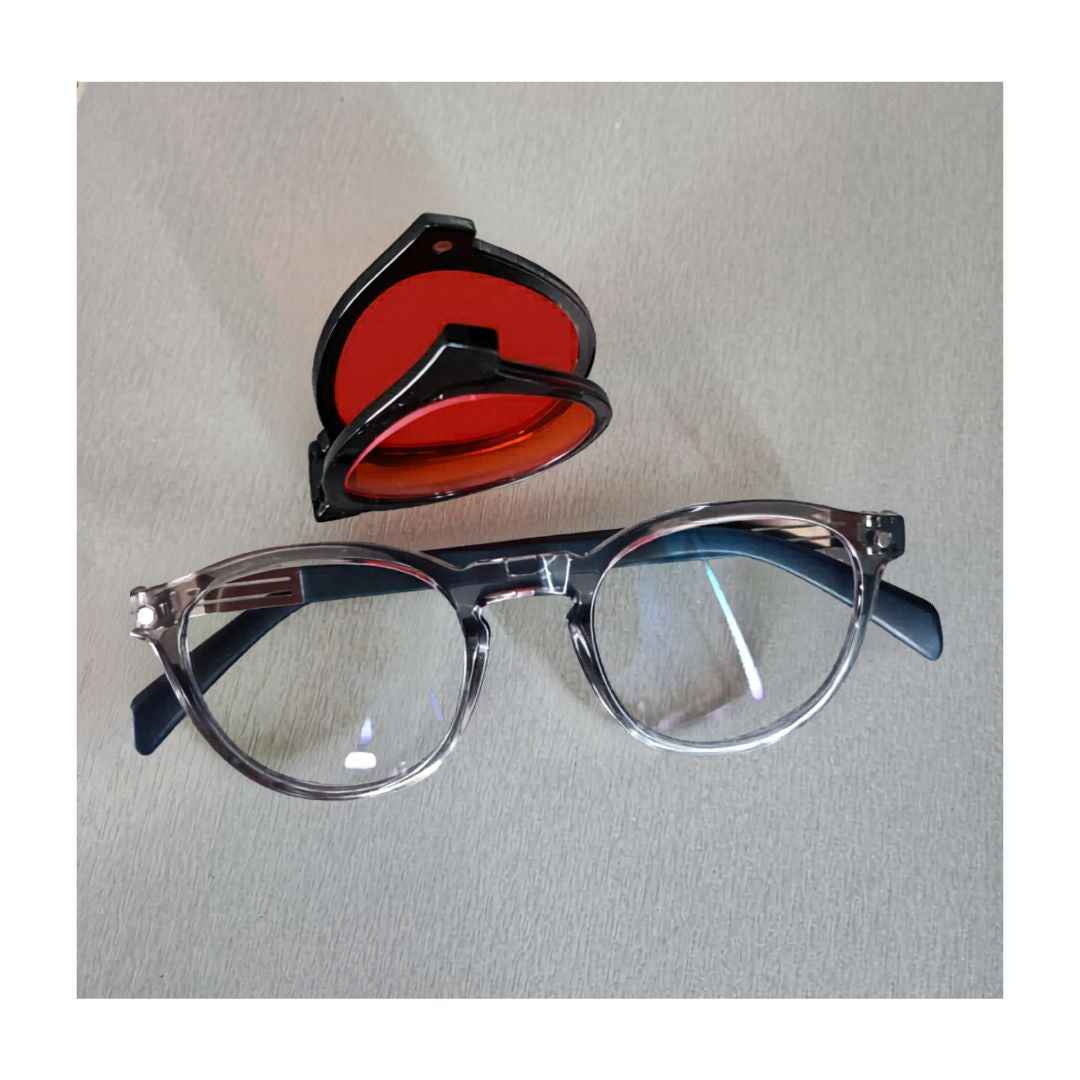
One frame. Two lenses. Clear for the working day, reduces screen strain without colour shift. Amber for the evening, blocks blue and cyan wavelengths to protect your melatonin from dinner onwards. Swap between them in seconds.
⟷ Day lens · Evening lens · One frameReduces digital eye strain from screens. No colour distortion, suitable for colour-accurate work, video calls, and normal daytime activities. Wear from the start of your working day.
☀️ Morning until ~18:00Blocks blue and cyan wavelengths to support natural melatonin production. Warm amber tint. Switch at dinner time, 2-3 hours before your target bedtime.
🌙 ~18:00 until sleepThe vast majority of blue light glasses are designed for one window of the day: evening use before sleep. That's the most critical window, and if that's all you need, the dedicated AfterDark evening frames handle it perfectly.
But if you spend 8-10 hours per day at a screen, which most Norwegian knowledge workers do, daytime screen exposure is also a real factor. Digital eye strain, afternoon headaches, and the accumulated blue light load going into the evening all matter. The Phase Shift is designed for that person: someone who wants daytime eye comfort and evening sleep protection without carrying two separate pairs of glasses or committing to the full four-lens Meridian system.
Two lenses. One transition point. Put the Clear on when you sit down to work in the morning. Swap to Amber when you start dinner. The magnetic system makes that swap take about five seconds.
Why not just wear evening glasses all day instead of buying two lenses?
Wearing an evening amber lens during the day works against you: it blocks the blue light your body needs for daytime alertness, and can leave you groggier by afternoon. The Clear lens solves that. Same frame, different job. Swap at dinner, not before.
If you're at a screen for most of your working day, and then use a screen again in the evening, the Phase Shift addresses both ends without requiring two separate pairs or a full four-lens system.
Working from home means the transition from work to evening is often abrupt and in the same physical space. The Phase Shift makes the shift deliberate, swapping lenses at the start of your evening is a genuine circadian signal.
One frame covers the work day and the evening. Compact, complete, nothing extra to carry. Particularly useful for overnight trips where you want both screen protection during a working day and sleep support in a hotel room.
The Phase Shift gives a new user both lenses from day one without the complexity of the four-lens Meridian. For someone who's never tried blue light glasses, this is a complete and uncomplicated introduction.
Reduces digital eye strain from prolonged screen use. Minimal visible tint, appropriate for video calls, colour-accurate work, and normal daytime activities.
Not for evening use, blue light from screens and lighting during the day is what your body uses to maintain wakefulness and anchor your circadian clock. You need that signal until the evening window begins.
Wear from morning until approximately 18:00.Warm amber tint. Blocks blue and cyan wavelengths that suppress melatonin production. Colour perception is shifted toward warm tones but functional, dinner, TV, and normal evening activities are all comfortable.
For the 2-3 hours before your target bedtime. This is the same protection window as the AfterDark Sundown Orange evening glasses, the Phase Shift simply packages it alongside the daytime Clear lens.
Swap on from dinner, 2-3 hours before sleep.Both are magnetic lens systems. The difference is in how many windows of the day you want to actively manage:
- One transition point: day to evening
- Simpler to manage
- Covers screen work and melatonin protection
- Right for most screen workers
- More compact to carry
- Three transition points across the full day
- Fine-grained control at each window
- Covers daytime, afternoon, evening, pre-sleep
- For those who want complete circadian optimisation
- Trial product, all sales final, priced lower
Meridian, All Day Complete Protection
Clear + Yellow + Orange + Red. Four windows, one frame. For those who want complete circadian control across the full day
Dedicated evening framesAfterDark Blålysbriller, All Frames
Dedicated evening frames with Sundown Orange or Moonlight Red. Ten styles from Obsidian to Arc
Evening lightingAmber & Red Evening Bulbs
Removes blue light from the whole room from the evening onwards. Glasses handle your eyes; bulbs handle everything else
Morning anchorRed Light Therapy Panels
Morning rødlysterapi anchors your circadian rhythm. The complement to evening blue light management

The Phase Shift came from a straightforward observation: most of the people who contact me about sleep problems also mention working long hours at screens. The two things are connected, the accumulated blue light load from a full working day going into an evening of more screens is a real contributor to the problem. Just addressing the evening window without touching the daytime exposure means you're solving half the equation.
The Clear lens doesn't block much, it reduces eye strain from the intensity and spectrum of screen light without cutting the blue light your body needs for daytime alertness. That's intentional. Then the Amber lens at dinner time does the actual melatonin protection work. Two lenses, one deliberate transition, a more complete picture than just evening-only glasses.
If you want more fine-grained control across the full day, the Meridian takes this further with four lenses. But for most people, two lenses and one transition point is the practical sweet spot.
📧 admin@lighttherapy.no · 📱 +47 951 47 478 (Text only)
⚠️ Safety notice: The Amber lens significantly alters colour perception and must not be used for driving or operating machinery. The Clear lens is for indoor daytime use only, not for outdoor UV protection. Evening use only for the Amber lens.
What lenses does the Phase Shift include?
Hva er forskjellen mellom Clear og Amber linsen i Phase Shift?
Who is the Phase Shift right for?
Can I wear the Clear lens all day at a screen?
Er Phase Shift et godt valg for folk som jobber mye foran skjerm?
Hjelper Phase Shift mot søvnproblemer og digital øyebelastning?
Both lenses included. Ships from Norwegian stock. 30-day returns.
Get the Phase Shift above →