

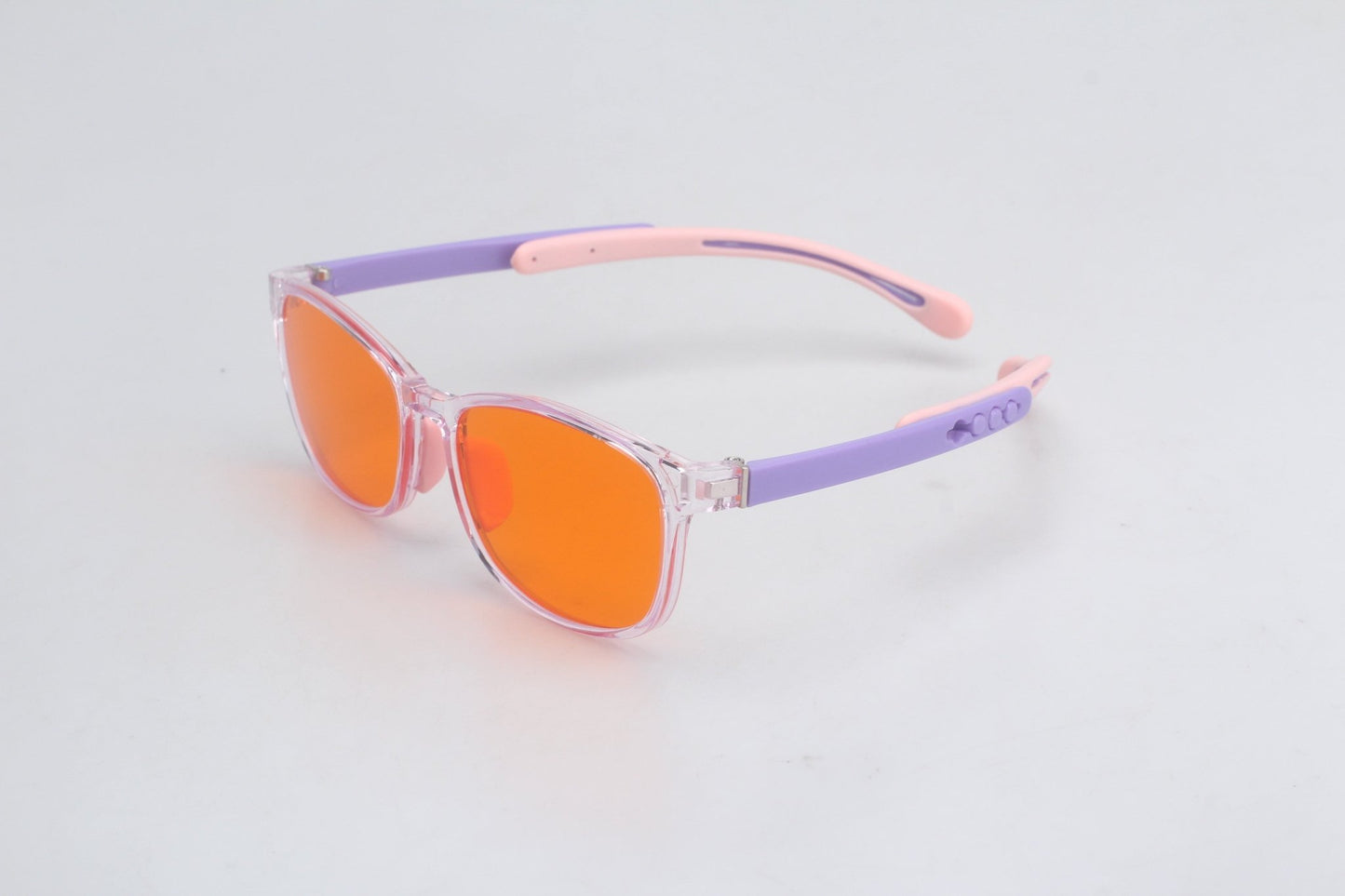
Starlight and Firefly - Kids Blue Light Blocking Glasses for Better Sleep
Norway is one of the worst countries on earth for children's sleep. Six months of artificial light dominating winter evenings, midnight sun in summer, and children among the most screen-exposed in Europe. These glasses let your child's nervous system wind down naturally in the evening instead of fighting their own biology every night.
Barnebriller med voksen linsekvalitet - barn sovner raskereNorway sits between 57 and 71 degrees North. That means six months of the year when the sun barely rises and children spend up to 16 hours a day under artificial LED lighting before bed. And then three months of summer where it's still light at 11pm and children are lying in bed wondering why they can't sleep when they can see daylight through the curtains.
Both of these are biological problems, not discipline problems. In winter, LED lighting emits the same blue wavelengths that tell the brain it's midday. In summer, evening daylight does the same thing. Either way, the signal your child's brain receives at 9pm is "it is not time to sleep yet." Melatonin stays suppressed. The child is genuinely not sleepy at the time you want them in bed.
And the problem runs deeper for children than adults. A child's crystalline lens is significantly clearer than an adult's, transmitting roughly 40-50% more blue light to the retina. The whole family sitting in front of the TV at 8pm in January - your child's sleep chemistry is being disrupted more than yours by the same screen.
These glasses are the most direct intervention available. They block the wavelengths that suppress melatonin. Put them on the child in the evening and their biology starts doing what it's supposed to do.
Most people buy these glasses for sleep. What surprises them is what happens before sleep - in the hour before bed when the glasses are on.
A child running high on cortisol and suppressed melatonin from evening screen exposure is not a calm child. The overtired, wired, resistant-to-bed version of your child that appears at 8:30pm is not a character flaw or a parenting problem. It's a nervous system that has been told by blue light all evening that it should be alert. When that stimulation stops and melatonin is allowed to rise, children calm down noticeably. Bedtime becomes easier not because anything changed in the bedtime routine, but because the child's nervous system is actually moving toward sleep rather than fighting it.
As melatonin rises with the glasses on, the nervous system begins its natural wind-down. Children become less wired, less resistant, and more cooperative in the 30-60 minutes before sleep.
Most parents notice their child falls asleep noticeably faster within a week of consistent use. Melatonin is rising as intended instead of being suppressed by screens until the moment the device is switched off.
A child who fell asleep at the right time in a genuine sleep state wakes more naturally. Better waking mood, less resistance to getting up, clearer for school.
Sleep quality is one of the strongest predictors of next-day concentration and emotional regulation in children. More and better sleep compounds over time into measurable differences in behaviour and focus.
The human crystalline lens naturally yellows with age, a process that begins in early adulthood and accelerates from the 40s onwards. This yellowing acts as a natural filter, absorbing progressively more short-wavelength blue light before it reaches the retina. Children haven't developed this filtering yet. A 7-year-old's lens is nearly optically clear, allowing almost all blue light from the 380-550nm range to reach the retinal ganglion cells that control melatonin secretion via the melanopsin pathway. The same 10pm TV session that modestly delays an adult's sleep can significantly delay a child's - and their next-day biology reflects that.
Starlight and Firefly are both sized for children's faces and use identical CE-certified, spectrometer-tested CR39 lenses. The choice is purely about which frame your child will actually agree to wear consistently.
A cleaner, more classic frame profile for children who prefer something closer to what an adult pair looks like. Works well for slightly older children who want something less playful.
A slightly more expressive frame shape - more character, more fun. Often preferred by younger children. The same protection, a style they are more likely to ask to wear.
If you are unsure which style to choose, involve your child in the decision. A frame they helped pick is a frame they will wear.
From October to March, children can go entire weeks barely seeing natural daylight. They wake in darkness, come home from school in darkness, and spend the evening under artificial LED lighting that continuously emits the blue wavelengths that suppress melatonin. By 8pm a Norwegian child in January may have had essentially no circadian signal telling their body the day is ending. The glasses provide that signal by removing the artificial evening light that blocks it.
Summer is often when Norwegian children's sleep collapses most visibly. Daylight past 10pm, light through windows at bedtime, the body clock pushed hours later than parents want. Children aren't being difficult - their melatonin genuinely hasn't risen. Moonlight Red lenses in the final hour before bed, combined with blackout curtains, is the most effective intervention available short of moving to a different latitude.
"Veldig fornøyd med disse blålysbrillene for barn! Når de først skal se på skjerm når det er mørkt ute, tas disse frem, og barna liker de godt. Anbefales!"
- Verified customer, Home Light Therapy Norway
Wireless Kids' Night Lamp - Red and Amber
Blue-light-free bedside lamp. The glasses handle screen time; this handles the bedroom light environment during the whole bedtime routine
Whole-room protectionAmber and Red Evening Bulbs
Replace living room and hallway bulbs with amber or red - removes blue light from the whole environment, not just what reaches the eyes through glasses
For the parentsAfterDark Adult Blålysbriller
Same lenses, adult sizing. Browse all ten frame styles - Obsidian, Classic, Ghost, Flight, Halo and more
Family guideeBook - Blue Light Blocking for Norwegian Families
40+ pages covering children's sleep, mørketid, midnattsol, and how to build a complete family circadian routine. 59 kr

The behaviour angle is the thing parents don't expect. They buy the glasses because their child won't fall asleep. What they notice first - often within a few days - is that the hour before bed gets easier. The child is calmer. There are fewer arguments. The transition to sleep happens without the resistance they'd come to treat as normal.
That's not magic. It's what happens when you stop giving a child's nervous system an alertness signal for two hours before you ask it to sleep. Blue light from screens keeps cortisol elevated and melatonin suppressed right up until the screen turns off. The glasses create a gap - an hour where the biology is moving in the right direction before you even try for sleep.
Norwegian conditions make this more important than almost anywhere. The winter problem is 16 hours of artificial light with no natural signal that the day is ending. The summer problem is daylight at 10:30pm that the child can see through the curtains. Both are solvable. The glasses handle the screen contribution; amber room lighting and blackout curtains handle the rest.
📧 admin@lighttherapy.no · 📱 +47 951 47 478 (Text only)
Safety notice: These glasses significantly alter colour perception. Must not be used for cycling, outdoor activities, or any situation requiring accurate colour vision. For stationary indoor evening use only. Supervise young children during initial use.
Can blue light blocking glasses help my child fall asleep faster?
Why is my child hyperactive and wired before bed after screen time?
Why do children need blue light blocking glasses more than adults?
Er blålysbriller trygge for barn?
Hvilken linse bør jeg velge - Sundown Orange eller Moonlight Red?
Hvorfor er norsk vinter og sommer spesielt hardt for barns søvn?
How soon will my child sleep better?
What is the difference between Starlight and Firefly?
Ships from Norwegian stock. 30-day returns. Spectrometer certificate included.
Choose style and lens above